
Are you part of the GCC (Global Capability Centre) model already? by Ram Arunachalam (ARR), E&I, 1996 Batch
For most professionals, the answer is a clear YES. There remains considerable ambiguity surrounding the buzzword GCC, with many perceiving it as an entirely new model and wondering if they’ve fallen behind in adopting it.
The Global Capability Centres (GCCs), also called Captives or Global in-house (GIH) centres, are no longer just low-cost delivery or back-office hubs. Over the last 2–3 years, they’ve moved toward innovation, IP ownership, product engineering, R&D and strategic business partnering.
If you’ve worked in an ODC or handled offshore delivery for years, you already have a strong base many GCCs value – some are process discipline, delivery rigour, stakeholder management, domain knowledge and operational scalability. But the expectations in modern GCCs are evolving to scale up into digital, product and leadership skills to remain relevant.
From task execution → to problem framing & product thinking. Instead of only delivering specs, you’ll be expected to shape product requirements, measure outcomes and iterate.
From single-tech stacks → to platform & systems thinking. Work now spans data platforms, cloud, MLOps, APIs and integrations.
From cost KPI → to business KPIs. Measure revenue impact, customer adoption, time-to-market, and technical ROI.
Leadership at scale. GCCs demand cross-functional collaboration, influencing HQ and building global stakeholder trust.
In short, you’re not starting from scratch in the GCC model. However, to move from a contributor in a delivery model to a strategic leader in a GCC, you need to reskill and reframe your career narrative.
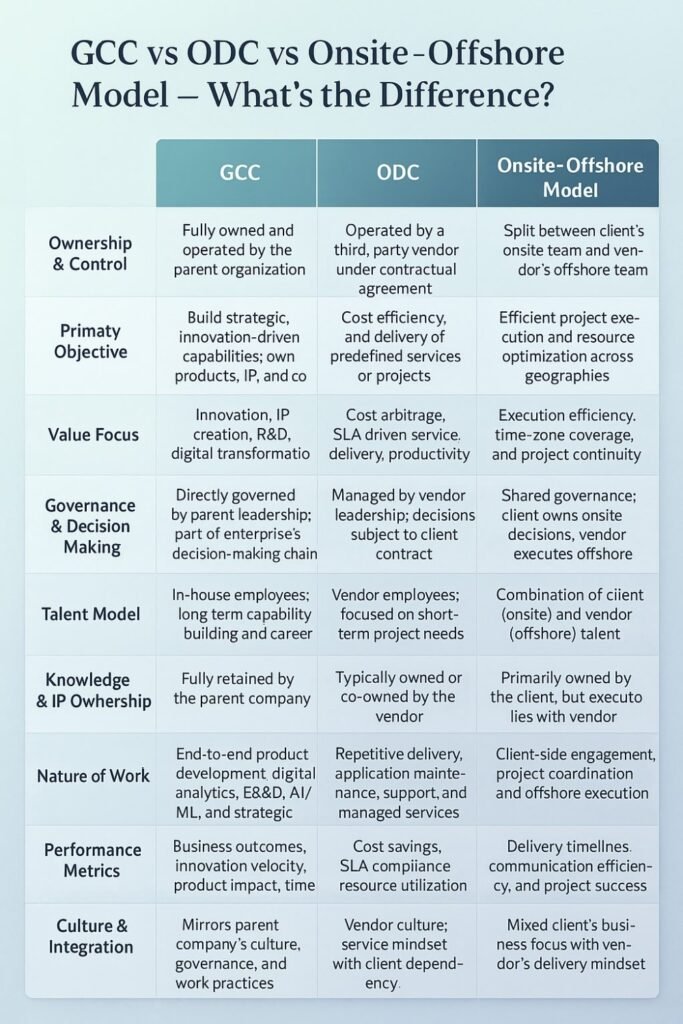
To provide better clarity, outlined here a comparative view of “GCC vs Outsourcing vs Onsite–Offshore — What’s the Difference?”
Given the reading appetite in today’s fast-scroll era, I’ll pause here to let this sink in first.
Please share your input and thoughts as well. Together, we learn.
~ Ram Arunachalam (ARR)